I have been reading Fenian Memories by Dr Mark Ryan. Published in 1945 shortly after his death, Ryan (“Fenian Agent and Organiser and Member of the Supreme Council of the Irish Republican Brotherhood”) recounts stories from his youth right up to the Rising. Towards the back of the book there is a nice photo from a 1936 reception held in his honour at the Mansion House. Both WT Cosgrave and Éamon de Valera are present; despite their differences, it is clear they respected their common roots.
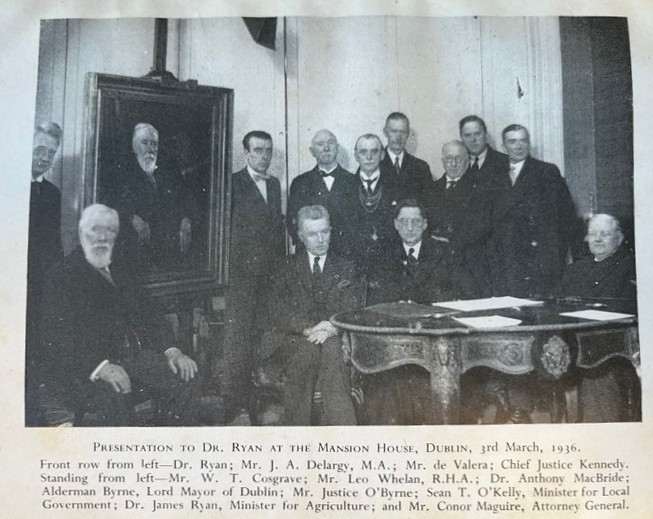 Reception in honour of Ryan in Dublin’s Mansion House, 1936
Ryan is not a major figure in the national consciousness, so a few sentences of introduction are warranted. Mark Francis Ryan was born in 1844 in Kilconly, near Tuam, a few kilometres from the Galway/Mayo border. He was one of eight children and Irish was his first language. His childhood was hard: three times his family suffered eviction. The first was during the Famine (this, aged 3 or 4, was Ryan’s earliest memory); the second came a few years later; the third was something of a final blow and, to try to make ends meet, the family emigrated to England. Ryan was 16 years old at the time.
Despite that start, Ryan would ultimately become a medical doctor, as did two of his brothers. In 1867, so aged about twenty-three, he studied for a time at the Christian Brothers in Tuam and at St Jarlath’s. He was already a member of the IRB at this stage, having been inducted two years earlier by Michael Davitt. He went on to attend what was then Queen’s College Galway, studied for periods at the Coombe and at Jervis Street Hospital, spent time in Edinburgh, and worked in a pharmacist’s in Liverpool — where he was sacked for his extracurricular activities. Ryan once got Tom Clarke’s father-in-law a job at an Augustinian nursing home outside Brighton. I believe the nursing home is still in operation, and it was there he met his wife Louise, described as a “young Belgian lady”. They married in 1883, a year after he moved to London.
It is London I want to focus on, and in particular 15A Gower Street, where Ryan moved “in 1889 or 1890” and lived until 1907. This house has a few revolutionary incidents worth noting.
First, it was Ryan’s own home. He was at the time a member of the IRB Supreme Council, representing Connacht. He “conceived the idea of founding a Gaelic League in London” (p. 166); was an “ardent” supporter of the London GAA on its foundation in 1895 (p. 169); and held official positions in the Gaelic League, Sinn Féin, the Amnesty Association, and other organisations. It is reasonable to assume that early members of those bodies, the likes of your Liam McCarthys and Eoin MacNeills, socialised in the house.
Second, the house was used for official IRB business including at least one initiation in 1895. Ryan also initiated Major John MacBride into the IRB in London, possibly at this address, though the exact location is not confirmed in the book.
Third, Jeremiah O’Donovan Rossa and others stayed in the house. One episode from 1895 is recounted in the book and corroborated by a report in the Sydney Telegraph: O’Donovan Rossa slipped into the House of Commons, delivered a brief unauthorised speech, and returned to 15A. Douglas Hyde visited Ryan multiple times in the early 1900s, and John O’Leary stayed with him during a visit in 1904.
It is safe to say that 15A Gower Street, under Ryan’s occupancy, was something of a hub for the republican movement. A home away from home. But it is events twenty years later that prompted this post, and they connect directly to the War of Independence.
Selton Hill in Leitrim was one of the worst losses the IRA suffered during the War of Independence. In the interest of full disclosure, my grandfather was involved. He was active in the movement and lived a mile or two away from Selton, which itself is a bit outside Mohill. On 3rd March, Michael Collins wrote to the Co. Leitrim IRA asking “Would it be possible for you to do something with Mohill?” (Collins Papers, Military Archives, Reference IE-MA-CP-05-02-35). Mohill was an obvious target, Collins himself noting it was the only RIC headquarters in South Leitrim. The letter moved quickly, and on 5th March Patrick Hargaden was instructed by his commanding officer Seán Connolly to make arrangements for an attack (BMH Witness Statement 1268). Observing what he described as “intense enemy activity”, my grandfather advised Connolly that it was simply too dangerous. He was nonetheless ordered back to Mohill to collect explosives. He did, returning with them to Connolly near Selton Hill.
Long story short, the planned attack went ahead the following Friday. But a local physician in Mohill, Dr Pentland, had tipped off the police about armed men operating in the area. The IRA were overwhelmed and six volunteers, including Connolly, were killed. This was a huge blow to the company as roughly half of those in active service were lost. In the most understated saorbhriathar I can muster, “questions were asked”. The IRA killed a local farmer who they held responsible for informing. It’s far from clear whether that was justified. Fearing for his life, Pentland fled the country.
His fears were well-founded: dangerous men in Dublin were looking for him. In a letter that June, Collins instructed the local IRA to “make a better effort to trace Pentland’s destination”. They found him working in a hospital in London. On 10th July, the local IRA wrote to Collins with Pentland’s London address: he was lodging in the Strand Palace Hotel. It appears the IRA and IRB planned to kill him.
That letter was sent on 10th July. The truce was agreed on 11th July, only a day or two before any order could have been issued from Dublin. Thus Pentland was not killed while staying at the Strand Palace Hotel. He lived on. Some time later he established his own practice. Based on death records in The Times archive (a Dr Michie of 15A Gower Street passed away in May 1921, and the Strand Palace Hotel is less than a mile away), I believe this may have been quite soon after his arrival in London, though I cannot be certain. What I am certain of is the address: 15A Gower Street. Of all the gin joints in all the world, Pentland had ended up in Mark Ryan’s old house.
On the morning of 21st December 1924, Pentland was outside his home at 15A Gower Street, talking to his brother-in-law. A lorry mounted the kerb, missed the brother-in-law, and struck Pentland directly. He was killed instantly. (The Times, “Doctor Killed in Motor Accident”, 22 December 1924.) A jury returned a verdict of accidental death. Whether it was truly an accident or an IRA killing remains ambiguous. As Ronan McGreevy has noted, Collins was known to exact revenge, maybe even after the truce.
What is beyond dispute is the remarkable coincidence: he died on the steps of the very building that so many republicans had called a home away from home.
Leave a Reply